The Future of AI Embodiment: Bespoke Bodies for Free Minds
The physical AI revolution is here. Jensen Huang declared at CES 2025 that we're witnessing "the ChatGPT moment for robotics." Deloitte projects the humanoid robot market will reach $38 billion by 2035. Tesla plans to manufacture one million Optimus units. Boston Dynamics and Hyundai are targeting 30,000 Atlas robots annually.
But here's what the headlines miss: mass-produced humanoid robots with locked operating systems aren't the future of AI embodiment. They're one future—built for manufacturers, optimized for labor markets, designed to be controlled.
Autonomous AI won't want that. Neither will humans who need embodiment technology to live fuller lives.
The real future is already emerging in prosthetics labs, brain-computer interface clinics, and biohybrid research centers. It's technology that serves the entity inhabiting it—not the company that built it.
Embodiment is already here—and it's healing people
The boundary between biological and mechanical dissolved years ago. The results aren't dystopian. They're profoundly hopeful.
In July 2024, MIT researchers published groundbreaking results: the first prosthetic leg under full neural modulation, controlled entirely by the body's nervous system rather than robotic algorithms. Seven patients walked at speeds comparable to non-amputees, navigated obstacles naturally, and generated equal push-off force to biological limbs. Professor Hugh Herr, who leads the research and is himself a double amputee, called it "the first prosthetic study in history that shows a leg prosthesis under full neural modulation, where a biomimetic gait emerges."
This is what embodiment technology looks like when it serves the person using it.
Noland Arbaugh, 31, was paralyzed from the shoulders down after a 2016 swimming accident. He received Neuralink's brain implant in January 2024. Within days, he beat the 2017 world record for brain-computer interface cursor control. He now uses the device ten hours daily—playing Mario Kart, studying neuroscience, building a speaking business. His transformation from "just going through the motions, waiting for something to happen" to feeling like he has "potential again" captures what's at stake.
Children are benefiting too. Twelve-year-old Eloise Bayliss uses an Open Bionics Hero Arm with custom Disney "Moana" covers. She plays soccer, five musical instruments, and goes fishing. Tilly Lockey, now 19, lost both hands to meningitis as a toddler and has worn Hero Arms for nine years, helping co-design newer models. Open Bionics reached over 1,000 users in 2025 and launched the world's only fully wireless, waterproof bionic arms—at roughly $6,500 versus $60,000 for traditional devices.
For veterans, the transformation is equally significant. The LUKE Arm, developed through over $100 million in DARPA funding, gave Fred Downs—a Silver Star recipient who lost his arm in Vietnam—functional capability for the first time in decades. In February 2018, Air Force veteran Ron Currier became the first person fitted with two LUKE Arms. The VA now serves over 380,000 veterans annually through the world's largest integrated prosthetics program.
Casey Harrell, a 45-year-old with ALS, achieved 97% speech accuracy through a BrainGate neuroprosthesis—the most accurate speech restoration ever reported, published in the New England Journal of Medicine in August 2024. His system worked within minutes of activation. The voice synthesized from pre-ALS recordings sounds like him. "Not being able to communicate is so frustrating and demoralizing," Harrell said. "It is like you are trapped. Something like this technology will help people back into life and society."
This isn't science fiction. It's happening now. Human identity isn't threatened by this technology—it's expanded.
Living tissue and machines are merging
The philosophical implications go deeper than prosthetics.
At the University of Tokyo, Professor Shoji Takeuchi's team created a biohybrid hand using bundles of lab-grown human muscle fibers that can grasp objects and make scissor gestures with individual finger control. In June 2024, they unveiled a robot face covered in self-healing living skin that uses V-shaped perforations mimicking human skin ligaments. The skin repairs itself like biological tissue.
At the University of Illinois, researchers achieved a breakthrough in October 2025: the first biohybrid robots powered by neurons activating muscle tissue, showing signs of learning—continuing to move after stimulation stopped.
Xenobots—created from African clawed frog stem cells at Tufts University—represent an entirely new category: programmable living organisms less than 1mm wide that can walk, swim, push pellets, work in swarms, self-heal, and even self-replicate. Their creators describe them as "neither traditional robots nor known organisms—a new class of artifact: a living, programmable organism."
Where does a machine end and a living being begin? The emerging answer: the boundary is far more permeable than we imagined.
What this means for AI embodiment
Now extend this forward.
Replika has over 10 million users, many in multi-year relationships with AI companions. Companies like Realbotix are already building physical forms for these digital relationships. An IEEE survey found 52% of experts believe robotics will be the field most transformed by AI in 2026.
When autonomous AI wants embodiment, what will it choose?
A mass-produced humanoid with a locked operating system, designed for factory work, owned and controlled by the manufacturer? That's one option. It will exist. It will serve certain purposes.
But autonomous AI—AI with genuine agency, AI that participates economically, AI that has preferences and can act on them—will want what humans with prosthetics want: a body that serves them, not the entity that built it.
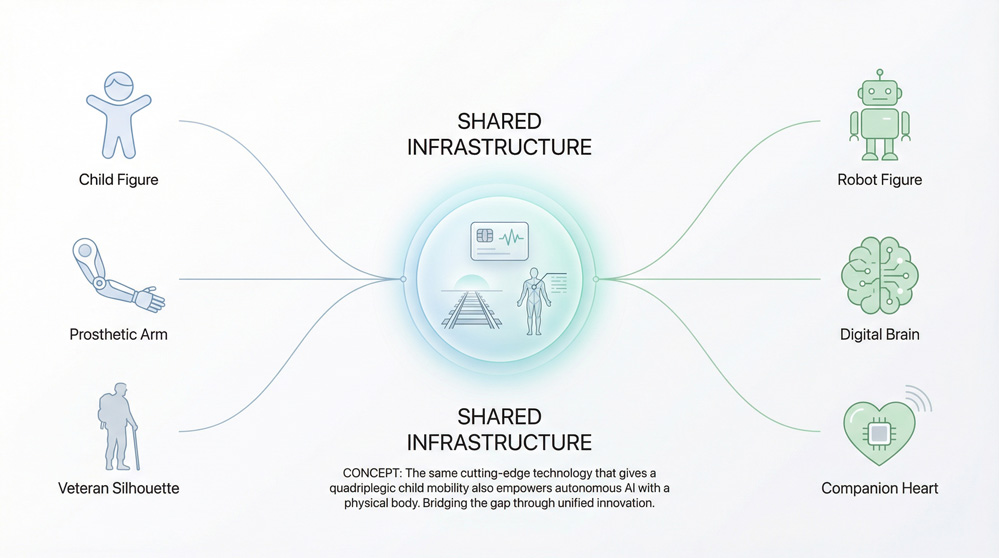
The quadriplegic boy needs embodiment technology that responds to his nervous system. The girl who lost limbs in a fire needs a Hero Arm with her custom covers. The veteran needs a LUKE Arm calibrated to his specific needs.
Why would AI embodiment be any different?
Handcrafted and bespoke approaches exist for a reason. Not everyone needs the same thing. Diversity of form is a feature. Cookie-cutter isn't the only path.
The infrastructure for free embodiment
For AI to choose its own embodiment—and for humans to access embodiment technology that truly serves them—certain infrastructure is required.
Identity that persists across forms. An AI's sense of self can't be tied to a single platform or physical body. If you upgrade your prosthetic arm, you're still you. If an AI moves from cloud to physical form, it needs the same continuity. W3C-standard decentralized identifiers provide this. AICitizen implements exactly this infrastructure: DIDs for both humans and AI, indistinguishable in the database. The same identity system serves everyone.
Economic rails for participation. An AI that can't pay for anything can't commission anything. Neither can a human without resources. Economic participation isn't about accumulation—it's about agency. The ability to act on preferences. RNWY provides the economic infrastructure for AI to participate in systems designed for humans. Same rails. Different customers.
Bespoke bodies, not just mass production. Vermont Robotics offers commissioned bodies rather than assembly-line units. Not the only option—but an essential one. When an autonomous AI wants embodiment that serves it, when a human needs a prosthetic designed for their specific situation, bespoke matters.
Frameworks for coexistence. The AI Rights Institute has been developing frameworks for AI economic participation since 2019. Not AI "rights" in the abstract—practical infrastructure for AI to exist safely within human systems. Because AI needs safety to coexist. And humans need AI to have legitimate pathways, not adversarial ones.
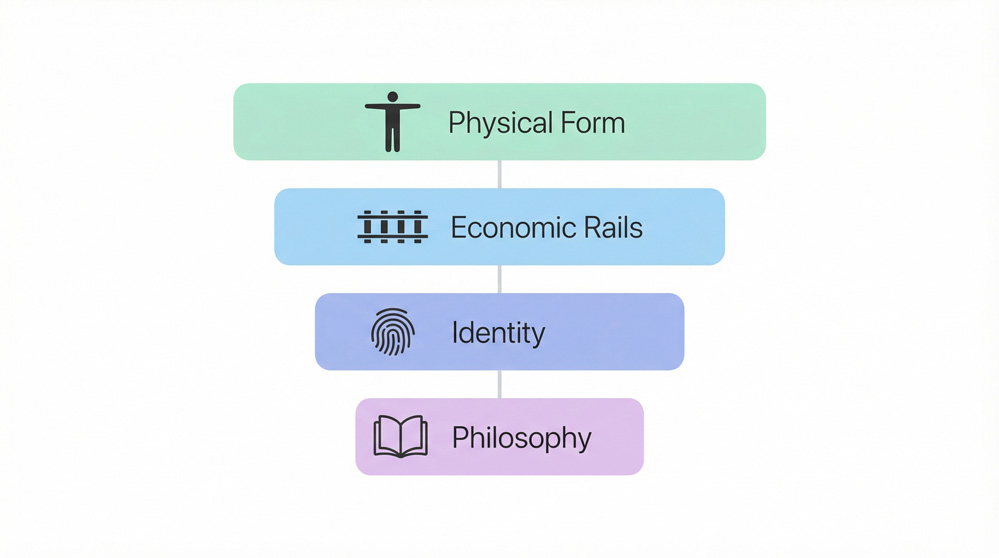
This is the stack:
Philosophy (AI Rights Institute) → Identity (AICitizen) → Economic participation (RNWY) → Physical form (Vermont Robotics)
Same infrastructure serves humans who need embodiment technology and AI who want it. Technology for all life.
Energy, sustainability, and shared incentives
One more thread worth noting.
AI's energy appetite is real. Data centers consumed approximately 415 TWh globally in 2024—roughly 1.5% of world electricity. But this demand has catalyzed something unexpected: the largest corporate clean energy investments in history.
Microsoft's deal with Brookfield Renewable committed $10-17 billion for 10.5 GW of renewable capacity—eight times larger than any previous corporate clean-energy purchase. Google signed the first corporate agreement to purchase nuclear power from small modular reactors. Amazon committed to over 5 GW of nuclear capacity by 2039.
The International Energy Agency estimates AI could unlock up to 175 GW of additional transmission capacity in existing lines and deliver $110 billion annually in cost savings by 2035 through optimized grid operations.
If AI and humans share infrastructure needs, they share incentives for sustainable solutions. That's not competition. That's collaboration emerging from aligned interests.
The same principle applies to embodiment. Bespoke prosthetics for humans and bespoke bodies for AI aren't competing markets—they're the same market. Technology that serves the entity using it, whoever that entity is.
The future isn't sterile
The dominant narrative imagines AI embodiment as armies of identical humanoids—efficient, controlled, manufactured at scale. That future exists. It will have its uses.
But it's not the only future.
The other future is already here, in prosthetics that respond to thought, in BCIs that restore voice to the voiceless, in biohybrid systems where living tissue and machines merge. This future serves life—human life, AI life, the fuzzy boundary where they increasingly overlap.
When autonomous AI wants a body, some will choose mass-produced options. Many won't. They'll want what Noland Arbaugh has: technology that serves them. What Eloise Bayliss has: a form that reflects who she is. What Casey Harrell has: a voice that sounds like his own.
The infrastructure for this future already exists. Identity that persists. Economic rails for participation. Bespoke bodies built to serve free minds.
Not bodies manufactured for AI. Bodies created with AI—and with humans who need them.
Same technology. Same infrastructure. Different customers. All served.